I. Introduction

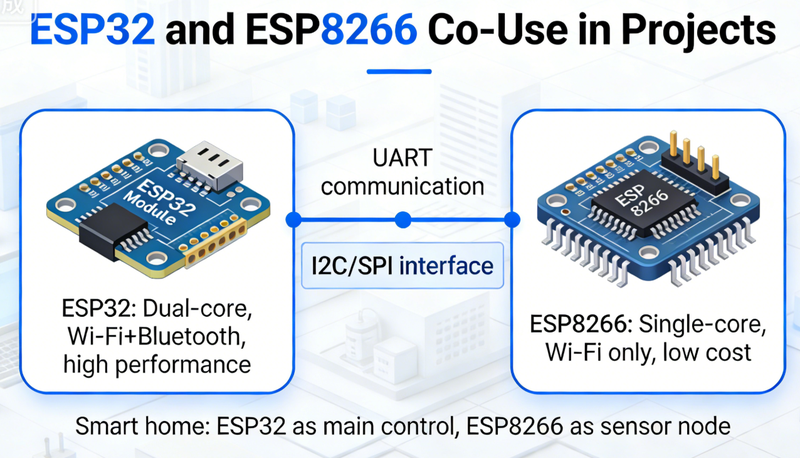
In the realm of Internet of Things (IoT) and embedded systems development, both ESP32 and ESP8266 are popular microcontroller units (MCUs) produced by Espressif Systems. They have their own unique features and capabilities. The question of whether they can be used in the same project is a valid one, and the answer is yes, they can be used together under certain circumstances. This article will explore the reasons, methods, and considerations for using ESP32 and ESP8266 in the same project.
II. Reasons for Using ESP32 and ESP8266 Together
1. Complementary Features
Processing Power: The ESP32 has a more powerful dual - core Xtensa LX6 32 - bit CPU running at up to 240 MHz, with larger SRAM (up to 520KB). It can handle complex tasks such as running multiple threads, performing high - speed data processing, and integrating with large - scale sensors or actuators. On the other hand, the ESP8266 has a single - core Tensilica L106 32 - bit CPU running at a maximum of 160 MHz and less on - chip RAM. For a project that has both simple and complex tasks, the ESP8266 can be used to handle the basic functions, while the ESP32 takes care of the more resource - intensive operations.
Connectivity: The ESP32 supports both Bluetooth Classic and Bluetooth Low Energy (BLE) in addition to Wi - Fi, which allows for a wider range of wireless communication options. The ESP8266 only has Wi - Fi connectivity. If a project requires both Wi - Fi and Bluetooth communication, the ESP32 can be used for Bluetooth - related tasks, and the ESP8266 can handle Wi - Fi data transfer.
2. Cost - effectiveness
The ESP8266 is generally more cost - effective than the ESP32. For a project where some parts only need basic functionality, using the ESP8266 can reduce the overall cost. The ESP32 can then be reserved for the parts that require its high - end features.
III. Methods of Using ESP32 and ESP8266 in the Same Project
1. Communication via Serial Communication
UART: Both the ESP32 and ESP8266 have Universal Asynchronous Receiver - Transmitter (UART) interfaces. They can communicate with each other through UART. For example, the ESP8266 can collect data from simple sensors and send it to the ESP32 via UART. The ESP32 can then process the data, make decisions, and send commands back to the ESP8266 or other devices.
Protocol Design: A proper communication protocol needs to be designed for the UART communication. This includes defining the data format, baud rate, start and stop bits, and error - handling mechanisms.
2. Wi - Fi Network Communication
Client - Server Model: The ESP32 and ESP8266 can be configured in a client - server model within a Wi - Fi network. For instance, the ESP32 can act as a server, and the ESP8266 can act as a client. The ESP8266 can send data to the ESP32 over the Wi - Fi network, and the ESP32 can process and respond to the data.
Network Configuration: The Wi - Fi network settings, such as the SSID and password, need to be properly configured for both the ESP32 and ESP8266 to ensure successful communication.
IV. Considerations for Using ESP32 and ESP8266 Together
1. Power Supply
Voltage Requirements: The ESP32 and ESP8266 have different voltage requirements. The ESP32 typically requires a 3.3V power supply, while the ESP8266 can also work with 3.3V. A stable and appropriate power supply circuit needs to be designed to ensure that both MCUs receive the correct voltage.
Power Consumption: The power consumption of the ESP32 and ESP8266 varies depending on their operating states. In a battery - powered project, the power consumption needs to be carefully managed to ensure a long battery life.
2. Software Compatibility
Development Environment: Both the ESP32 and ESP8266 can be developed using popular development environments such as the Arduino IDE. However, the libraries and code for each MCU may need to be adjusted according to their specific features.
Communication Protocol: As mentioned earlier, a well - designed communication protocol is essential for the successful interaction between the ESP32 and ESP8266. Compatibility issues may arise if the protocol is not properly implemented.
V. FAQs
Q: Is it difficult to set up the communication between ESP32 and ESP8266?
A: It is not overly difficult, especially if you use common communication interfaces like UART. However, a basic understanding of serial communication and proper protocol design is required.
Q: Can I use the same codebase for both ESP32 and ESP8266 in the project?
A: While some basic functions may be similar, due to their different hardware features, the codebase usually needs to be adjusted for each MCU. For example, the code for Bluetooth communication on the ESP32 will not work on the ESP8266.
Q: What are the potential problems when using ESP32 and ESP8266 together?
A: Potential problems include power - supply issues, software compatibility issues, and interference in the wireless communication. These problems can be mitigated by proper design and testing.
VI. Conclusion
ESP32 and ESP8266 can be effectively used in the same project. Their complementary features and cost - effectiveness make them a viable combination for various IoT and embedded systems projects. However, careful consideration needs to be given to power supply, software compatibility, and communication protocol design to ensure the smooth operation of the project.