I. Introduction

The ESP32 and ESP8266 are two popular microcontroller chips developed by Espressif Systems, widely used in the field of Internet of Things (IoT). While they share some similarities in their application scenarios, there are significant differences between them. Understanding these differences can help developers choose the most suitable chip for their projects.
II. Architecture and Performance
1. CPU
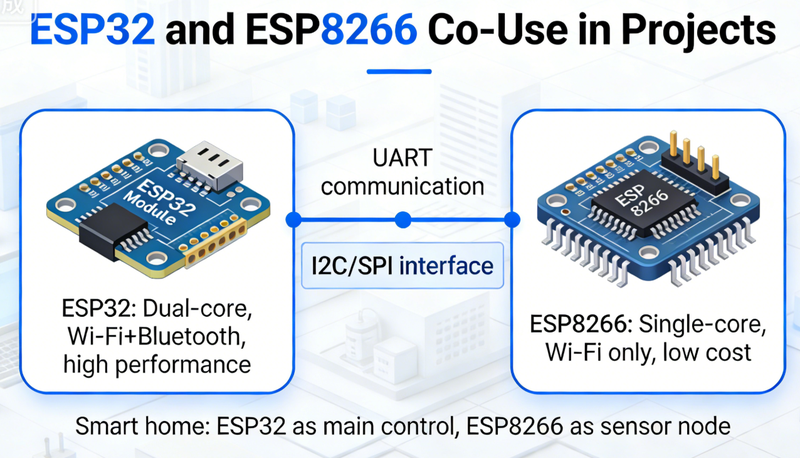
ESP8266: The ESP8266 is equipped with a single - core Tensilica L106 32 - bit CPU, which runs at a maximum frequency of 160 MHz. This CPU provides sufficient processing power for basic IoT applications, such as simple sensor data collection and transmission.
ESP32: The ESP32 features a dual - core Xtensa LX6 32 - bit CPU, with each core capable of running at a maximum frequency of 240 MHz. This dual - core architecture allows for more complex tasks, such as running multiple threads simultaneously, handling high - speed data processing, and supporting real - time operating systems.
2. Memory
ESP8266: It has a limited amount of on - chip RAM, typically 64KB of instruction RAM and 96KB of data RAM. This can be a constraint when dealing with larger applications or more complex data processing.
ESP32: The ESP32 offers a much larger memory capacity. It has up to 520KB of SRAM, which provides more space for variable storage, stack, and heap, enabling the development of more memory - intensive applications.
III. Connectivity
1. Wi - Fi
ESP8266: The ESP8266 supports 802.11 b/g/n Wi - Fi standards. It is mainly designed for basic Wi - Fi connectivity, suitable for applications where a stable but relatively low - speed Wi - Fi connection is required.
ESP32: In addition to supporting 802.11 b/g/n Wi - Fi standards, the ESP32 also offers improved Wi - Fi performance, including higher data transfer rates and better co - existence with other wireless devices. It can also operate in both station and access point modes simultaneously, which is useful for creating more complex network topologies.
2. Bluetooth
ESP8266: The ESP8266 does not have built - in Bluetooth capabilities. This can limit its use in applications that require Bluetooth communication, such as connecting to Bluetooth sensors or devices.
ESP32: The ESP32 supports both Bluetooth Classic and Bluetooth Low Energy (BLE). This makes it suitable for a wider range of applications, including wireless audio streaming, Bluetooth - based sensor networks, and communication with mobile devices.
IV. Power Consumption
1. ESP8266
The ESP8266 has relatively low power consumption, especially in sleep modes. This makes it a good choice for battery - powered IoT devices where long - term battery life is crucial. However, its power consumption may increase significantly when performing high - load tasks.
2. ESP32
The ESP32 offers more flexible power management options. It has multiple power - saving modes, allowing developers to optimize power consumption according to the specific requirements of the application. In general, the ESP32 can achieve a good balance between performance and power consumption, making it suitable for a variety of power - sensitive applications.
V. Peripherals
1. GPIO Pins
ESP8266: The ESP8266 has a limited number of General - Purpose Input/Output (GPIO) pins. This can be a limitation when the application requires multiple external devices to be connected.
ESP32: The ESP32 has a larger number of GPIO pins, which provides more flexibility for connecting various sensors, actuators, and other external devices.
2. ADC and DAC
ESP8266: The ESP8266 has a single - channel 10 - bit Analog - to - Digital Converter (ADC), which can be used to read analog sensor data. However, it does not have a built - in Digital - to - Analog Converter (DAC).
ESP32: The ESP32 has multiple ADC channels with higher resolution (up to 12 - bit), as well as two built - in DAC channels. This allows for more accurate analog signal processing and the generation of analog output signals.
VI. Cost
ESP8266: Due to its simpler architecture and more limited features, the ESP8266 is generally more cost - effective. It is a popular choice for low - cost IoT projects where the functionality requirements are relatively basic.
ESP32: The ESP32, with its more powerful performance and richer features, is usually slightly more expensive than the ESP8266. However, considering its capabilities, it offers good value for money in projects that require high performance and advanced functionality.
VII. FAQs
Q: Can I use the same development environment for both ESP32 and ESP8266?
A: Yes, both ESP32 and ESP8266 can be developed using popular development environments such as the Arduino IDE, which provides a unified programming interface for developers.
Q: Which chip is better for a simple IoT temperature sensor project?
A: For a simple IoT temperature sensor project, the ESP8266 is a good choice as it has sufficient processing power and Wi - Fi connectivity for basic data collection and transmission, and it is more cost - effective.
Q: Can the ESP32 replace the ESP8266 in all applications?
A: In most cases, the ESP32 can replace the ESP8266 as it offers better performance and more features. However, for some ultra - low - cost projects with very basic requirements, the ESP8266 may still be a more suitable option.
VIII. Conclusion
The ESP32 and ESP8266 each have their own advantages and disadvantages. The ESP8266 is a cost - effective solution for basic IoT applications, while the ESP32 offers more powerful performance, richer connectivity options, and better peripheral support, making it suitable for more complex and demanding projects. Developers should choose the appropriate chip based on the specific requirements of their projects.